Your affordable and professional tree service in Atlanta Ga, Fast Tree Removal Services Atlanta offers expert, fully licensed and insured emergency tree removal services, tree trimming and tree cutting services in Metro Atlanta.
http://www.fasttreeremovalatlanta.com
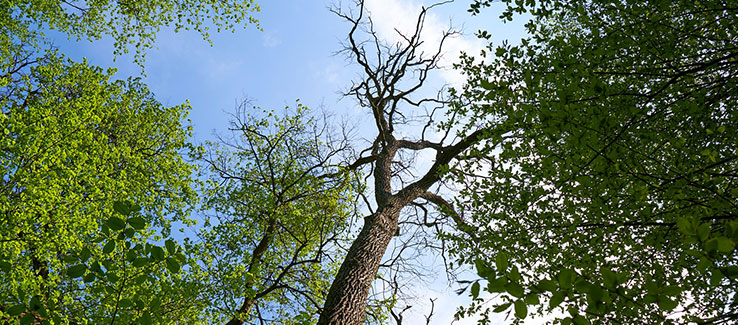
Prevent catastrophic damage by knowing when your oak tree is dying. Knowing how to identify when an oak tree is troubled or in decline will help you save it or remove it before causing costly property or personal injury.
fasttreeremovalatlanta.com gathered the following information about dying oak tree symptoms, the diseases, the infestations, and other conditions to help you determine whether to treat or remove your oak tree.
Signs of A Dying Oak Tree
The following are indicators that your oak tree is dying and what actions should be taken to save your tree or remove it.
Tree Boring Insect Infestations
Boring insects like the southern pine beetle, red-headed ash borer, red oak borer, Asiatic oak weevil, and carpenterworms can be identified by the following:
Small rounded exit holes
Crown and branch dieback
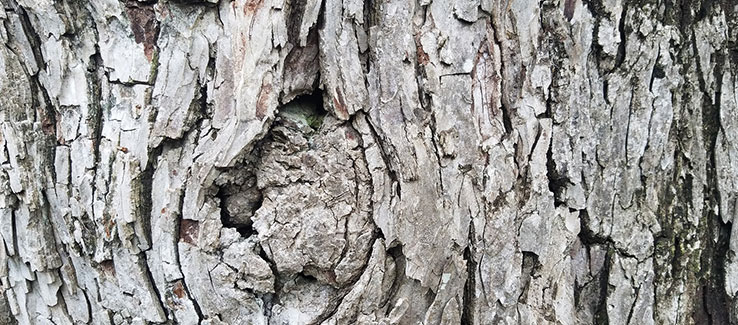
Deeply cracked Bark
Cankers
Foliage chlorosis and wilting
Bulging bark (above the galleries)
Sightings of adults feeding on the tree’s foliage
Higher than normal squirrel activity
Woodpecker activity
Many of these visible symptoms occur due to hydraulic failure or girdling caused by the boring insect’s tunneling through the tree’s cambium (xylem and phloem, which transport nutrients and water from the crown to the roots and back).
Note: If left unchecked, many boring insects will re-infest the host tree season after season until killing it.
Tree Boring Insect Solutions
Typically, by the time a boring insect infestation is discovered, it is exceptionally challenging to save the infested tree. The following should be done to contain the infestation:
Set baited traps to catch emerging adults
Chemically treat uninfected trees with residual insecticides such as carbaryl or pyrethroid insecticides such as bifenthrin or permethrin
Carefully prune and destroy all affected branches
When the infestation reaches the tree’s trunk, removal may be the only option (topical sprays and treatments will have no effect)
Tree boring insects typically attack the trees that are already in decline. You can help neighboring trees by promoting their health and vigorous growth.
Tip: Don’t try to eliminate a boring insect infestation alone. Contract an ISA certified arborist to guide you through your options.
Tree Fungal Infections
Healthy oak trees are highly resistant to fungal infections. That said, when an oak (or any other tree species) finds itself stressed, fungi can successfully attack the tree, making it its host. The following symptoms may indicate an advanced fungal infection:
Cankers (discolored areas or depressed places on the bark)
Bark swelling
Twig and branch dieback
Partial or total crown chlorosis (yellowing)
Carpenter ants nesting in the tree (they don’t consume the wood, rather they remove decaying wood to form galleries within the heartwood)
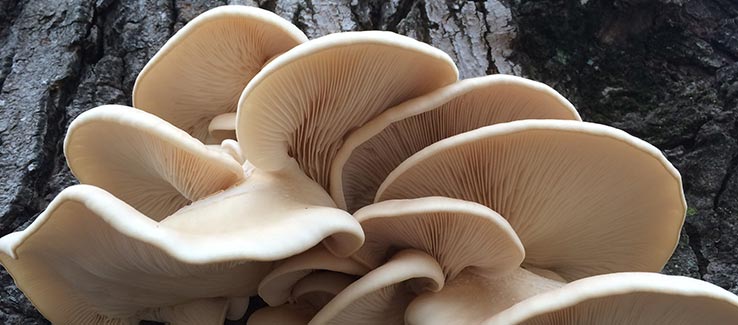
Mushroom Conks (fruiting structures) growing from the trunk or root flare
Boring insect infestation••
**Ambrosia, oak wilt, and fusarium are examples of fungi using boring insects as their vector.
Tree Fungal Infection Solutions
Healthy trees are quite capable of compartmentalizing (sealing off) fungal infections. However, when a tree is stressed from drought, nutritional deficiencies, infestations, etc., infections can run wild and quickly overcome the tree. The following can be done to contain a fungal infection:
Carefully prune and destroy (burn) infected limbs and branches (avoid pruning activities from mid-April to mid-July to reduce tree disease infection and spread)
Sanitize all equipment before and after use on infected trees
Nurture the tree, watering, mulching, and fertilizing it to encourage vigorous growth
Avoid overhead watering or splashing water which can spread infections from tree to tree
Use an insecticide to halt carpenter ant activities
Apply fungicides as recommended by an ISA certified arborist
Treat surrounding healthy trees and vegetation with copper fungicides (to avoid the infection’s spread)
Tip: For carpenter ant infestations, mix equal parts vinegar and water in a spray bottle, then spray the mixture into a carpenter ant nest. This should eradicate the entire colony.
Note: Most cases of fungal infections producing mushrooms on the trunk or roots or resulting from boring insect infestations will likely require removing the tree.
Brittle Tree Bark and Cracks
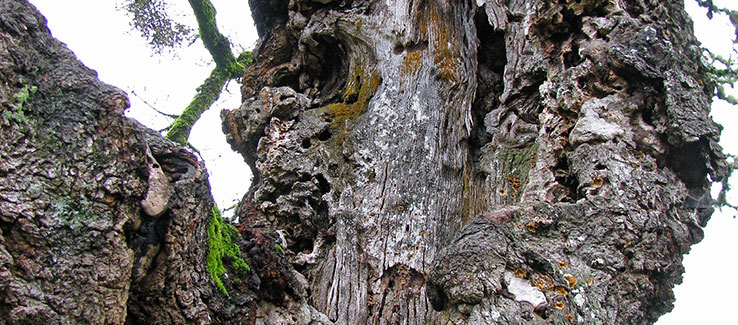
As a tree dies, bark may begin to slough off the tree. Verticle cracks may also form along the trunk or along limbs. Observe the following:
When cracks in tree bark are spotted, inspect them to see if the crack has developed into the tree’s wood.
Identify cracks that run into external or internal cavities.
Note: As a tree dies, it dries out, leading to such cracks, bark loss, and severe instability. Trees in this condition may suddenly topple, especially during storms.
Brittle Tree Bark and Crack Solutions
When sloughing tree bark and cracks are isolated in limbs and branches, you can do the following:
Immediately prune out these branches
Have a tree risk assessment performed by an ISA certified arborist
The urgency to remove this dead wood is to prevent the tree from dropping these limbs on its own (cladoptosis), potentially causing catastrophic damages.
Note: Sometimes, removing dead or dying branches is enough to save your tree or, at least, buy it some time. However, once this condition spreads to the tree’s trunk, it is better to have the tree removed before it falls or collapses under its own weight.
The Tree Is Leaning
Trees are highly efficient at maintaining balance throughout their life. However, severe weather events, root diseases (root rot), or irregular growth can cause a tree to destabilize and lean. Consider the following actions:
Stake or brace the tree, slowly winching it back to an upright growth pattern (this often works for younger trees)
Remove the tree before it completely destabilizes
Tip: Corrective actions should be taken under an arborists supervision.
Note: Mature trees that have toppled or suffered windthrow in severe weather or winds are highly unlikely to ever recover.
How To Save a Dying Oak Tree
Sick trees will often display similar signs that a dying or dead tree would, but not as widespread. Not all trees displaying these conditions need to be removed immediately. Some of these conditions can be treated, prolonging the tree’s life.
The chances of saving your oak tree are reliant on your swift action, the amount of damage the tree has sustained, and your contacting an ISA certified arborist as soon as you detect any signs that your tree is in trouble.
Performing regular tree care and maintenance like pruning, disease and pest prevention measures, and correcting poor structural growth or damage will improve your tree’s health.
Dying Oak Tree Solutions
In this article, you discovered information on how to detect the symptoms of a dying oak tree, including the diseases, infestations, and conditions contributing to your tree’s declining condition.
Taking swift action to identify, treat, and get professional help for your tree significantly increases the chances of saving it.
Ignoring the signs of a declining tree leaves it vulnerable to infestations, infections, and structural problems that will lead to its rapid decline and death.
Prevent tree boring insects from crippling and quickly killing your trees. By knowing how to identify when your trees have been attacked, you can take steps to halt the advancement of these killer bugs.
fasttreeremovalatlanta.com gathered the following information on tree boring insects, infestation signs, and how to treat infested trees.
Round-Headed Borers (Coleoptera: Cerambycidae)
Referred to as long-horned beetles in their adult stage, the larvae of these beetles tunnel beneath the bark and into their host tree’s heartwood. Some of the round-headed borer species include:
Locust Borer (Megacyllene robiniae) – This long-horned beetle can be found feeding on goldenrod and other flowers in the fall. Larvae hatch from eggs laid in tree bark crevices then tunnel into the inner bark, constructing cells in which they spend the winter months. It takes about a year before the larvae are fully grown and about an inch in length.
Watch this video for more information about locust borers.
Visible infestation symptoms include wet spots, oozing sap, and frass on the bark of black locusts.
Cottonwood Borer (Plectrodera scalator) – This beetle is frequently found on or attacking cottonwood, poplar, or willow trees. Adult beetles are active from May through August, and the larvae tunnel at the base of the trunk or below ground level. It takes about 2 years for this species to develop and emerge as adult beetles.
Multiple cottonwood borer attacks can result in defoliation, crown wilt, stem or branch dieback, and eventual death.
Red-Headed Ash Borer (Neoclytus acuminatus) – This is one of the more common wood-boring beetles. Red-headed ash borers feed on many wood species, including ash, oak, elm, and grapes. Adults can be found on log piles and frequently emerge from firewood.
Red Oak Borer (Enaphalodes rufulus) – This beetle attacks oak and maple trees and can be a serious threat in nurseries. Adults lay eggs individually in bark crevices during mid to late summer. Larvae then tunnel under the bark and into the tree’s heartwood.
Larvae usually tunnel completely around the trunk or branches they infest, resulting in girdling. Red oak borers feed on their host for more than one year before pupating in the chambers tunneled into the heartwood. Red oak borer damage kills limbs, terminals, or the entire tree and greatly increases the risk of secondary infestations and diseases.
Like other boring insect symptoms, red oak borer infestations can be detected by frass around buckled bark near the gallery entrance.
Twig Girdler (Oncideres species) – Damage from this borer occurs primarily from egg-laying. This insect affects pecan, mimosa, chinaberry, and huisache (sweet acacia). During the fall, adults girdle limbs by chewing a V-shaped groove entirely around twigs, branches, or terminals. Eggs are then deposited into the bark on the girdled branch away from the tree.
Watch this video for more about twig girdlers.
Girdled limbs eventually die and break, falling to the ground during high winds and storms. Damage can significantly disfigure a young tree and lead to secondary branching. Larvae are unable to develop in healthy sapwood. Removing and destroying girdled twigs and branches from the ground in winter and spring can significantly reduce this insect population.
Twig and Branch Pruners (Elaphidionoides and Agrilus species) – This insect species inflicts damage similar to that of twig girdlers on several tree species, including:
Pecan (Carya illinoinensis)
Persimmon (Diospyros kaki)
Redbud (Cercis canadensis)
Elm (Ulmus)
Hackberry (Celtis occidentalis)
Hickory (Carya)
Maple (Acer)
Oak (Quercus)
Sweetgum (Liquidambar styraciflua)
With twig girdlers, it’s the adults that inflict damage. With twig and branch pruners, it is the larvae that feed beneath the bark, girdling twigs and branches. Resulting damages accompanied by repeated attacks can jeopardize a tree’s health, leaving it susceptible to other harmful insect infestations and diseases.
Flat-Headed Borers (Coleoptera: Buprestidae)
These metallic tree-boring beetles have flattened, hard-bodied, and with short antennae. These beetles are beautiful insects with distinctive metallic colors (blue, green, copper, bronze, etc.). When flat-head borer larvae tunnel beneath the bark and/or into the sapwood, they leave oval or flattened, winding tunnels filled with frass. This tunneling can girdle trunks and branches, killing its host expeditiously.
Emerald ash borer (Agrillus planipennis) (EAB) – Adults are distinctive metallic green beetles that have killed hundreds of millions of ash trees in North America. The larvae feed on the inner bark of ash trees from early summer to mid-fall, causing hydraulic failure and death. Infested native ash trees are all susceptible to attack. The insect has also been found attacking white fringe trees (Chionanthus virginicus).
Watch this video for more information about the Emerald Ash Borer.
Flatheaded Apple Tree Borer (Chrysobothris femorata) – This species is a severe threat to small, stressed landscape trees, primarily flowering crab apples, hawthorns, and maples when stressed.
This aggressive borer may attack almost any hardwood tree that is stressed by:
Defoliation
Sun Scald
Drought
Soil Compaction
Mechanical Injury
Similar to an EAB infestation, it makes broad winding tunnels under the bark, destroying the phloem, cambium, and outer xylem. A single borer can girdle and kill a small tree.
Bronze Birch Borer (Agrilus anxius) – This borer is a severe threat to white or paper birch. Symptoms of an infestation include twig and branch dieback. With successive years of attack, the tree becomes progressively weaker until it is killed.
D-shaped adult exit holes are a clear indication of an infestation. Adult bronze birch borers are slender, olive-bronze beetles begin emerging, and laying eggs in mid to late spring.
Note: With the exception of species like the emerald ash borer, most of these borers are secondary invaders, occurring when a tree’s defenses are weakened by previous infestations and/or diseases.
Watch this video for more about birch tree issues.
Bark beetles (Coleoptera: Curculionidae)
Southern Pine Beetle (Dendroctonus frontalis) – This species is a primary threat to southern pine forests. Adult beetles are active during warmer months and disperse widely to healthy, injured, weakened, or stressed trees in the spring.
Six or more generations of beetles may occur within one calendar year. This beetle’s larvae tunnel beneath the bark, producing tunnels or galleries in patterns resembling the letter “S.” This tunneling disrupts the cambium layer, girdling the tree, and causing hydraulic failure.
Infested tree needles turn reddish-brown shortly after infestation during the summer months, and up to 3 months afterward in the winter.
Removal and careful destruction of infested trees can help prevent healthy trees in the vicinity from being attacked.
Watch this informative video about pine beetles.
Granulate Ambrosia Beetle (Xylosandrus crassiusculus) – This destructive beetle attacks healthy, stressed, or freshly cut:
Elm (Ulmus)
Oak (Quercus)
Pecan (Carya illinoinensis)
Peach (Prunus persica)
Sweetgum (Liquidambar styraciflua)
Dark reddish-brown adult female beetles tunnel into twigs, branches, or trunks, excavating a system of tunnels in the wood or pith in which eggs are deposited. Along with eggs, they introduce a fungus on which the larvae will feed after hatching.
Visible damage includes wilted leaves and protrusions of compressed wood dust from numerous small holes. Cankers can form at the damage site, eventually girdling the tree and killing it.
Chemical control of this beetle species is generally unsuccessful. Promoting the health and vigorous growth of your trees provides a more successful means of control, as ambrosia beetles tend to avoid attacking healthy, thriving trees.
Note: The European elm bark beetle (Scolytus multistriatus) is the carrier of Dutch elm disease. Dutch elm disease (DED) has decimated the US elm tree population over the past century.
Weevils are beetles and are almost entirely plant feeders. The majority of species are associated with a specific range of hosts, in some cases only thriving on a single species. Some of the species present in the US include:
Asiatic Oak Weevil (Cyrtepistomus castaneus) – This weevil is present throughout much of the East. Small, legless grubs find refuge in hardwood tree roots, surviving the fall, winter, and early spring. During this time, the grubs pupate and adults emerge during the spring to feed on oak and chestnut foliage. They feed on the margins of leaves, sometimes consuming all but the main veins.
Although Asiatic oak weevils feed primarily on oaks and chestnut, they have been known to attack other woody plants.
The Asiatic oak weevil has not developed resistance to insecticides as of yet. Just about any insecticide labeled for landscape use should give adequate control.
Chichí Weevil or Citrus Root Weevil (Diaprepes abbreviatus) – This species was discovered in southern California in 2005, where it affects citrus, avocado, and nursery stock. It is also known to infest sugarcane, tuber crops like potatoes, and many species of ornamental plants.
Female citrus root weevils can lay up to 5,000 eggs, depositing them in clusters on plant foliage. The weevil then folds and glues the leaves together. Larvae emerge from the eggs after one week, drop to the ground, and begin to burrow down to the host plant’s roots. Larvae cause significant damage as they feed on the roots for several months.
While the adult weevil feeds on the plant’s foliage, the larvae do the most damage. They often partially or entirely consume the taproot of the plant, which can kill it. Phytophthora is a common disease in plants attacked by this weevil.
The weevil spreads by cross-contamination when infested equipment plants, soil, and containers are moved or used from site to site.
Watch this video for more on Diaprepes root weevils.
Palmetto Weevil (Rhynchophorus cruentatus) – Most active in late spring and early summer, this weevil is native to Florida and is found as far west as southern Texas and South Carolina to the north. The palmetto weevil is the largest and only species of palm weevil in North America.
This weevil’s preferred plant species include:
Canary Island date palm (Phoenix canariensis)
Sabal palms (Sabal palmetto)
Coconut palms (Cocos nucifera)
Toddy palm (Caryota urens)
Bismarck palm (Bismarckia nobilis)
Saw palmetto (Serenoa repens)
Washington fan palm (Washingtonia robusta)
Tropical fan palms (Pritchardia beccariana)
Royal palms (Roystonea regia)
Blue latan palm (Latania loddigesii)
Palm trees are usually attacked when distressed, making transplanted trees a frequent target. Palmetto Weevils mate at the base of the branches where the females then deposit their eggs.
The grubs then bore into the palm tree, killing it. Damage is only visible after the larvae have turned into adult weevils, and by then, it is too late to save the tree. The life cycle of this weevil, from egg to adult, is about 80 to 85 days.
Note: While most weevil larvae do not bore into the cambium layer or heartwood of trees, they do cause enough damage to allow multiple successful attacks from other, more invasive, insect species.
Clearwing Borers (Podosesia syringae)
As adults, clearwing borers are delicate, wasp-like moths, active in the daytime. In this form, little to no damage is inflicted, as they only feed on nectar or not at all. The damaging larvae are whitish, hairless brown-headed caterpillars. Types of clearwing borers include:
Banded Ash Clearwing Borer (Podosesia aureocincta) – Attacks only ash, principally green ash (Fraxinus pennsylvanica). Most active in August and September.
Carpenterworms (Prionoxystus robinae) – These large larvae tunnel through the trunks of oak, elm, willow, ash, boxelder, poplar, cottonwood, black locust, and fruit trees. These larvae spend 2 to 3 years developing, feeding underneath the bark in the cambium, and later tunneling into the heartwood. Carpenterworms, unlike other larvae, enter and exit the trunk of the tree multiple times during their development.
Watch this video for more on carpenterworms.
Dogwood Borer (Synanthedon scitula) – Attacks flowering dogwood (Cornus florida). Infestations in young trees occur in the main trunk where mechanical injuries are present. Infestations in older trees typically occur near pruning scars, cankers, or cracked bark. Small wet areas on the bark indicate young borer activity in early summer.
Lilac Borer (Podosesia syringae) – This species attacks lilac, ash, and privet anywhere east of the Rocky Mountains. The majority of infestations occur from the root flare up to about 3 feet. Most active in April or May.
Peachtree borer (Synanthedon exitiosa) and Lesser Peachtree Borer (Synanthedon pictipes) – These borers attack trees of the Prunus species, including fruit and ornamental varieties. Peachtree borer larvae attack young trees, while the lesser peachtree borer seeks older trees.
The tree species most affected by clearwing borers include:
Ash (Fraxinus)
Dogwood (Cornus florida)
Lilac (Syringa vulgaris)
Oak (Quercus)
Rhododendron (Rhododendron ferrugineum)
Flowering Peach (Prunus persica)
Flowering Plums (Prunus cerasifera)
Flowering Cherries (Prunus serrulata)
Signs of a Clearwing Borer Infestation – Signs of a clearwing borer infestation can appear similar to those of other boring insects. Use the following to distinguish the difference:
Terminal shoots, branches, and the crown will show signs of dieback.
Cracked bark, cankers, and calluses may form around infestation sites.
Large limbs may die, be weakened to the point of falling in the wind, or be self pruned from the tree.
These borers leave coarse, dark frass behind in cracks in the bark.
When a Prunus species is successfully attacked, frass may be mixed with oozing sap or gum.
When adults emerge from the tree, they leave an empty shell (pupal skin) protruding from the bark.
Tip: As woodpeckers and other birds hunt the larvae, they leave feeding holes behind. This is a significant indication that your tree is infested.
Note: Older, more established trees may be re-infested year after year until they eventually die or fall.
Wood and Tree Boring Insects
When dealing with a tree boring insect infestation (suspected or confirmed), call on an ISA certified arborist’s knowledge and experience. Locate an arborist in your area by visiting treesaregood.org/findanarborist
If you suspect or have a confirmed emerald ash borer infestation, visit emeraldashborer.info/reporting-eab.php to identify the correct agency for reporting the infestation.
Insect webs can lead to tree decay, disease, and death, so be vigilant about spotting pests and insects in your trees. You can also contact your state’s forestry service for information about potential and current threats in your area. Visit fs.usda.gov/about-agency/contact-us/regional-offices to locate a regional office in your area.
Disclaimer: If you choose to use chemical treatments on affected trees, cut wood, and/or ground soaks, locate, read, and follow all manufacturer’s advisories and recommendations.
Tree Killing Boring Insects
In this article, you discovered species information, traits, and treatment for some of the most destructive tree boring insects.
By knowing how to identify trees in decline and the pest causing it, you can take quick measures to save your tree and/or contain an insect’s outbreak.
Ignoring an attacked tree’s signs can result in the spread and perpetuation of a deadly tree boring insect infestation.
Don’t let your tree die when its leaves start turning black. Knowing what causes leaves to turn black and drop can help you spring into action, saving your tree and protecting your landscape.
fasttreeremovalatlanta.com gathered the information why, and steps to take when your tree’s leaves start turning black and falling off your tree.
Why Do Tree Leaves Turn Black?
There are many reasons your tree’s leaves can turn black and fall off the tree. The following are some of the more probable causes:
Hot Weather and Drought – During times of drought, trees are more susceptible to being damaged by radical changes in temperature.
Sudden rises in temperature can leach the moisture out of your trees and cause its leaves to wither, brown, and blacken.
While it isn’t feasible to control the weather, you can help your trees survive radical temperature fluctuations by doing the following:
• Increase the frequency of deep watering • Decrease the amount of fertilizer applied • Mulch your trees
During times of drought coupled with high temperatures, your tree’s internal processes speed up. Over-fertilizing may cause your trees to consume more nutrients than they can process, causing fertilizer burn and hastening their death.
Boring Insect Infestations – When trees are stressed by hot weather, disease, or poor care practices, they become highly susceptible to successful insect attacks. Namely, beetle attacks.
Beetle infestations often result in leaf wilt, severe defoliation, and the blackening of the leaves. When a tree or stand of trees falls victim to a beetle infestation, treatment must begin immediately to slow or halt an infestation of epidemic proportions.
Some of the signs of a successful beetle infestation include:
• Unseasonal leaf color change • Premature leaf drop • Crown wilting • Blackening of the foliage • Entry holes • Sawdust found on limbs and trunk
Infested trees are challenging to treat without killing the tree itself, and should be left to a tree professional. However, unaffected trees in the vicinity should be treated with insecticides to deter beetle attacks.
Ash trees are highly vulnerable to the deadly emerald ash borer. However, when their foliage blackens, it is more likely from an anthracnose infection than the borer.
NOTE: It is common practice to remove and destroy heavily beetle-infested trees to protect a wooded area or stand of healthy trees. In some instances, uninfected diseased trees that have become susceptible to beetle infestations may also be removed to prevent the spread of the beetle.
The ambrosia beetle is another boring insect that affects many tree species throughout North America. Learn more about the damage it causes and how to treat an infestation by reading fasttreeremovalatlanta.com/ambrosia-beetle-damage-treatment
Anthracnose Tree Disease – This disease is often referred to as leaf spot or leaf blight. It may be caused by several different fungi. The following are some of the common symptoms indicating that your tree is infected:
• Irregular dead spots on leaves • Formation of cankers on twigs, branches, and the trunk • Wilting and blackening of affected foliage • Premature leaf drop • Bud death (resembling frost damage)
Treatment for anthracnose includes the systematic application of fungicides in late winter and early spring, and the extensive pruning of affected areas of the tree.
Diseases like anthracnose are easily transmitted from one tree to another, usually by splashing water, overhead watering, and rainwater. Another common form of transmission is through the gardening and pruning tools used for your landscaping. Read about disease prevention tips at fasttreeremovalatlanta.com/5-tree-shrub-disease-prevention-tips
NOTE: Any time more than 25% of a tree’s crown must be pruned, call in a professional tree service to evaluate the health of the tree and potential alternatives to pruning.
Anthracnose is rarely lethal to mature trees. Still, repeated annual infections can cause the decline of the tree’s health, leading to infestations, disease, and the eventual death of the tree.
There are insecticides, fertilizers, and fungicides that can be applied throughout the year to protect your trees. However, the most effective measure to take in preventing your trees from withering in the heat, succumbing to boring insects, or contracting lethal diseases is to promote their health relentlessly.
The following are measures you can take to promote the healthy growth of your trees:
• Conduct annual soil tests to determine nutrient deficiencies and pH adjustments • Adjust your watering schedule to keep the soil moist but well-drained • Maintain organic mulch over the root plate throughout the year • Correctly prune your trees to encourage spring growth • Have your trees and landscape inspected annually by a professional tree service to detect any potential issues.
Your vigilance in keeping your trees healthy is perhaps their greatest ally in reaching maturity and living their lives pest and disease-free.
When Tree Leaves Turn Black
In this article, you discovered why tree leaves can turn black, and the steps you can take to help your tree recover and prevent future occurrences.
When problems arise, and they will, your immediate response is fundamental to the preservation of a robust landscape filled with healthy trees.
Your inaction or indifference will result in the decline of your tree’s health, its eventual death, and the potential to fall on your property or cause severe injuries.